
Rekey Locks: Repair or Replace? How Los Angeles Homeowners Decide
If the question is “can I keep my existing lock and just make the old keys useless,” the answer is rekey and in Los Angeles it typically costs $20 to $40 per lock cylinder. If the question is “is my lock still physically capable of doing its job,” the answer might be replace, and that’s a $45 to $150 decision per lock depending on hardware grade. The two jobs solve different problems. Rekeying changes who can open the door. Replacement changes how well the door resists being forced or picked. Most LA homeowners need a rekey far more often than they need a replacement, but when a replacement is the right call, rekeying instead is money spent on a lock that’s already failed its one job.
A locksmith who immediately recommends replacement when you ask about rekeying isn’t necessarily upselling you, but you won’t know the difference unless you understand what rekeying actually can and can’t fix. This guide walks through exactly how to tell which fork you’re standing at, using real Los Angeles pricing and the scenarios we see most often in homes from Echo Park to Westchester. And if you’d rather skip the research and just get a straight answer, call us at (409) 405-4485 and we’ll tell you over the phone which one you need, no service call required to hear the truth.
What Rekeying Actually Does, in Plain English
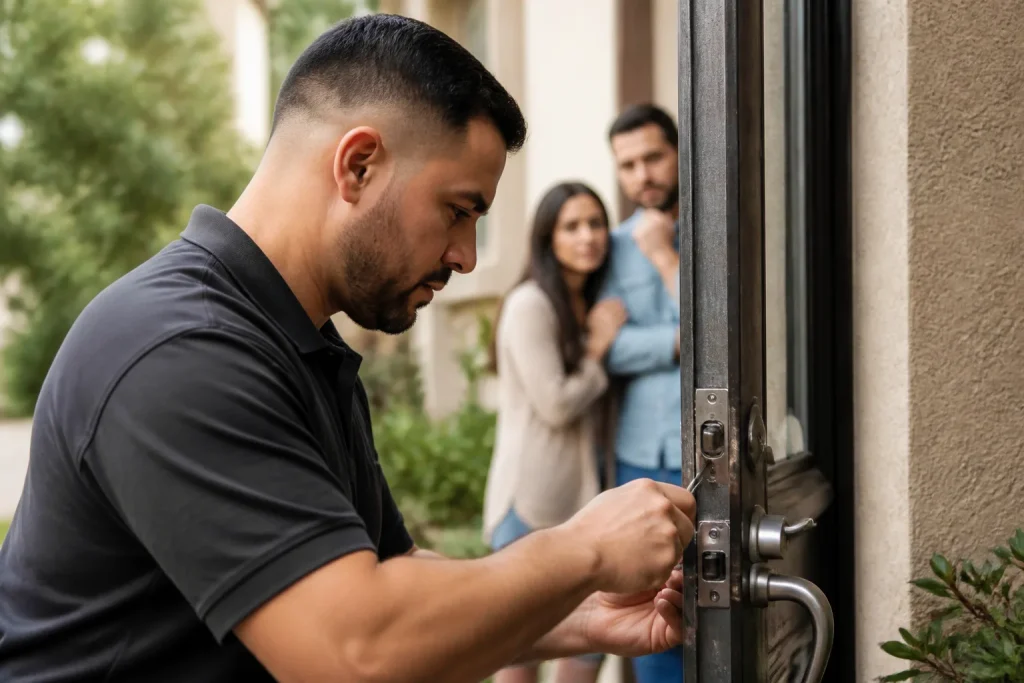
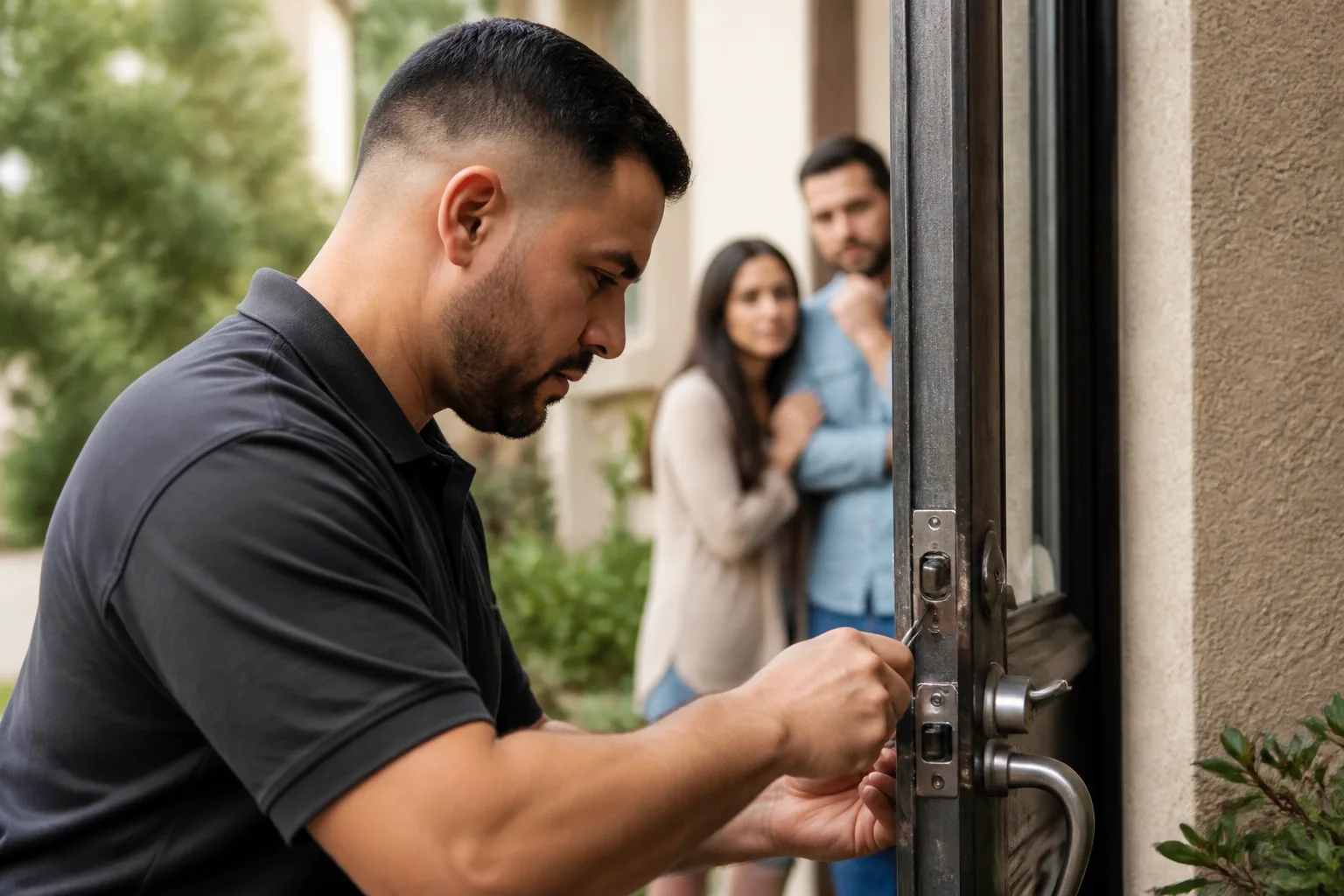
Rekeying means taking the lock cylinder apart and swapping the internal pins so the old key no longer turns it. The lock body, the handle, the deadbolt, the strike plate, the door itself: none of that changes. You get new keys. Old keys become useless. The whole job takes about 10 to 15 minutes per lock in a standard residential setting, and in Los Angeles you’ll usually pay $20 to $40 per cylinder for the service, often with a service call fee that runs $40 to $75 depending on your neighborhood and time of day. The written price we quote before dispatching a technician to any Los Angeles address includes everything: the pins, the new keys, the labor, the trip. The price on the phone is the price on the invoice, no arrival surcharge and no “well, it’s a weird lock” markup.
What rekeying does not do is upgrade anything physical. If your lock was a Kwikset with standard pins and a basic cylinder before we rekeyed it, it’s a Kwikset with standard pins and a basic cylinder after. Same pick resistance. Same drill resistance. Same bolt throw. Same ANSI grade stamped on the face. That’s the detail most homeowners in Los Angeles don’t get told, and it matters more than most locksmith blogs let on.
Key takeaway: Rekeying is a credential reset, not a hardware upgrade. It solves the people problem. It does not solve the hardware problem. Those are two separate jobs and any honest locksmith will tell you which one you’re actually facing.
Learn more about the full process on our Rekey Locks in Los Angeles page.
When Rekeying Is the Complete Solution
Most of the calls we take at Preston Locksmith & Security are rekey calls, and most of those are exactly the right call. Here’s the short list. If your situation is on this list, rekeying fixes the entire problem and you should not let anyone talk you into replacing perfectly good hardware.
- New tenant or property turnover. You bought a place, or you’re renting it out, and you have no idea how many copies of the old key are floating around Boyle Heights or Sherman Oaks. Rekey every exterior cylinder. Done. The hardware was installed before you got there but if it’s Grade 2 or better and functions smoothly, it’s fine.
- Lost key. You don’t know where it went, which means you should assume someone might. Rekey the affected locks. No need to remove the deadbolt from the door.
- Ex-partner, roommate, or housekeeper with a key. This is a people problem. Rekeying makes every existing copy of the old key dead metal. Takes one visit, costs less than dinner for two in Los Angeles.
- Moved into a new home. Previous owner, their dog walker, their contractor, their cousin: all had keys. Change the credential without changing the hardware. This is the single most common reason we rekey locks across Los Angeles every month.
- Key control after a renovation. Contractors, painters, stagers, real estate agents. Rekey when the project closes out so the only working keys are the ones in your hand.
In all these cases the lock itself is doing its job. The cylinder turns. The deadbolt throws. The hardware isn’t the problem. Who has a working key is the problem. Rekeying is not a compromise in these scenarios; it’s the correct repair, full stop.
One thing that surprises LA homeowners: you can rekey multiple locks to the same key, even if they’re different brands, as long as the cylinders accept the same key profile. We do this all the time, keying a Schlage deadbolt and a Kwikset knob alike where possible, so one key opens everything. It’s not always possible across different brands, but it’s common enough that we check for it on every rekey visit.
When Rekeying Is Never Enough
Now for the other fork. Sometimes the lock has already failed and a new key in a broken cylinder is a waste of your money. Here’s how to tell the difference before you call, and what to look for when you open your front door tonight.
- The key sticks, grinds, or only works at a specific angle. The cylinder’s internal pins or springs are worn or corroded. Rekeying replaces the pins but if the cylinder housing is damaged, the new pins will jam just like the old ones. This is a replacement situation, usually $45 to $90 for a new cylinder in LA.
- The deadbolt is loose in the door. Grab your deadbolt and wiggle it. If the whole assembly moves, the issue is the hardware or the door prep, not the key. On older Los Angeles homes with wood doors that have expanded and contracted through decades of moisture fluctuation, we see this constantly. Rekeying won’t fix a lock that’s pulling away from the door.
- The lock is below ANSI Grade 2 and you’re actually worried about security. Grade 3 locks are builder-grade, the kind that came with the door. They can be popped or bypassed quickly. In a city with the property-crime volumes Los Angeles sees, a Grade 3 lock on a street-facing door is a real risk. Rekeying it doesn’t upgrade it. Replacing it with a Grade 1 or Grade 2 lock does.
- The strike plate or door frame is compromised. If someone has already kicked the door once, or the frame is split, or the screws holding the strike are short and decorative, the strongest lock in the world won’t help. The frame is the weak link. That’s a repair plus possibly a new lock, and it’s well beyond what rekeying can touch.
- The finish or the hardware is physically broken. Cracked housing, snapped tailpiece, a thumbturn that spins without engaging. Cosmetic vs. functional: if the lock no longer locks or unlocks consistently, replacing is cheaper than nursing it along.
We pulled a deadbolt out of a garage door in Mar Vista last month where the owner asked for a rekey. The cylinder turned fine with the key out, but the key wouldn’t insert all the way. Turned out the previous owner’s kid had shoved a paperclip into the keyway six years ago and it rusted in place. A rekey would have been throwing money at a broken cylinder. We replaced it in 20 minutes and the door finally locked from the outside for the first time since 2019. That’s the difference: if the hardware can’t keep its half of the bargain, a new key is irrelevant.
If you’re seeing any of these signs, our Door Lock Repair in Los Angeles page explains what a proper fix involves.
How to Check Your Lock’s Security Grade Before the Locksmith Arrives
You don’t need any tools for this. You need a flashlight and about 30 seconds per door. Inside Los Angeles homes, the telltale details are almost always visible if you know what you’re looking at.
First, look at the face of the deadbolt or knob. You’re looking for a small stamped label that says “ANSI Grade 1,” “Grade 2,” or “Grade 3.” Grade 1 is commercial-level, overkill for most homes but unbeatable for security. Grade 2 is the residential sweet spot: strong enough to resist most forced-entry attempts, available from Schlage and Kwikset at reasonable prices. Grade 3 is the one to worry about. If your exterior door has a Grade 3 lock and you’ve been rekeying it every time a tenant turns over, you’ve been changing keys on a lock that a determined person can defeat in under a minute.
If there’s no ANSI stamp, that’s its own answer. Unrated hardware is typically imported and built to a price point, not a standard. Replacing it should be your default position if that door faces the street, an alley, or a shared courtyard.
The good news: a replacement doesn’t have to be expensive. A solid Schlage or Kwikset Grade 2 deadbolt runs $45 to $85 in Los Angeles, and installation adds another $45 to $75 at most. For a few hundred bucks total, you’ve gone from a lock that rekeying can’t save to one that’ll do its actual job for 10 to 15 years. And we’ll rekey that new lock to your existing key if you want one key for the whole house.
Rekey vs. Replace: The Cost Math in Los Angeles
Let’s put real numbers on this because vague pricing is how LA homeowners get burned. Here’s what you should expect to pay in this city, based on the jobs we do every week.
| Service | Typical LA Price Range | Includes |
|---|---|---|
| Rekey per cylinder | $20 to $40 | New pins, new keys, labor |
| Service call fee | $40 to $75 | Trip to your door, diagnosis |
| Replace Grade 2 deadbolt | $45 to $85 | Hardware only |
| Installation labor | $45 to $75 per lock | Removal, install, test |
| High-security cylinder (Mul-T-Lock or similar) | $150 to $300 per lock | Hardware plus install |
Here’s the decision shortcut. If rekeying is the answer, you’re looking at roughly $60 to $115 total for a typical LA home with two or three exterior cylinders, including the service call. If replacement is the answer, a full exterior upgrade to Grade 2 hardware on three doors runs $270 to $480 depending on the locks you choose. That’s the gap. It’s real money. Which is exactly why you should understand the decision instead of letting a stranger make it for you.
And one more thing that matters a lot in this trade: the price we quote on the phone at Preston Locksmith & Security is the price on the invoice. Written price before any work starts, always included, never an upgrade. If we tell you rekeying is all you need, that’s what you’ll pay. No bait pricing, no “actually it’s a special cylinder” on arrival. If the lock needs more than rekeying, we’ll show you with photos before we touch it.
Why Rekeying a Cheap Lock Doesn’t Make It a Good Lock
This is the piece most Los Angeles homeowners never hear, and it’s the one that separates a real locksmith from a guy with a drill and a van.
Pick resistance is a hardware attribute. A lock’s vulnerability to picking, bumping, or raking depends on the cylinder design: the number of pins, whether they’re standard or security pins like spools and serrated pins, whether there’s a secondary sidebar mechanism. Rekeying replaces the pins with new pins. It does not change the cylinder’s design or its resistance to manipulation.
Here’s what that means in practice. If you bought a house in East Hollywood with a Grade 3 Kwikset deadbolt from 2007, and you rekey it because the previous owner’s sister still has a key: yes, the sister is locked out. But the lock itself is still as pickable as it was yesterday, last year, and in 2007 when it was installed. It was never designed to resist a skilled or determined attacker. In a dense Los Angeles neighborhood where foot traffic is constant and a person kneeling at a door for 90 seconds doesn’t draw a second glance, that’s not a hypothetical risk. It’s a known entry vector.
If you care about pick and bump resistance, the answer is a high-security cylinder. Brands like Mul-T-Lock and Abloy build cylinders with design features specifically intended to defeat conventional picking and bumping. They cost more, $150 to $300 per lock installed in LA, and for most homes they’re overkill. But for a house with a lot to protect, or a home office with client data, or a ground-floor apartment on a busy street, they earn their price. The point isn’t “everyone needs high-security locks.” The point is: rekeying does not get you there. If that’s the goal, say so and we’ll quote you the right hardware. If it’s not the goal, save your money and just rekey.
For Los Angeles businesses and property managers, this same logic applies at scale. Our Commercial Locksmith in Los Angeles service handles key control and high-security hardware for offices, retail spaces, and multifamily buildings.
How to Decide in 60 Seconds
Here’s the framework we use when a friend calls and asks, rekey or replace. Ask yourself two questions, in this order:
- Is the lock physically working properly? Key turns smoothly, deadbolt throws fully, nothing wobbles, nothing sticks. If yes, continue. If no, replace or repair, don’t rekey.
- Is the lock at least ANSI Grade 2? Check the stamp. If you have a Grade 2 or better lock that’s working properly, and the problem is just who has keys, rekey it. If the lock is Grade 3 or unrated and you’re already paying for a service call, consider replacing it at the same visit.
That’s it. That’s the entire decision tree. It takes longer to find the flashlight than it does to answer both questions.
When to call a pro
If you’ve gone through the checklist and you’re still not sure, or you found a Grade 3 lock and want a real second opinion, or the key sticks and you don’t want to make it worse by forcing it: call a locksmith who will answer the question honestly over the phone before anyone gets in a van. That’s how we work. Call (409) 405-4485, describe what’s happening, and we’ll tell you whether you need a rekey or a replacement, and what it should cost, before you ever book an appointment.
Related services in Los Angeles
If this guide helped you figure out the rekey side, start with our Rekey Locks in Los Angeles page. If you’ve got a hardware problem, our Door Lock Repair in Los Angeles service covers everything from stuck cylinders to frame repair. And if you’re a business owner or property manager juggling multiple doors, our Commercial Locksmith in Los Angeles team handles key control at scale. You can also see everything we do on the Preston Locksmith & Security home page.
The Bottom Line
Rekey your locks when the hardware works and the problem is who has a key. That covers new homes, new tenants, lost keys, and removed keyholders. Expect to pay $20 to $40 per cylinder plus a $40 to $75 service call in Los Angeles, with new keys included. Replace your locks when the hardware is broken, worn, below ANSI Grade 2, or when you actually want a security upgrade, not just a credential change. Expect $45 to $150 per lock for standard replacement, and $150 to $300 per lock if you’re choosing high-security hardware like Mul-T-Lock or Abloy.
The truth is most LA homeowners call us thinking they need new locks and actually just need a rekey. The write-up is fast, the price is set before we start, and the whole visit usually wraps in under an hour. If you’re in Los Angeles and want a straight answer, call Preston Locksmith & Security at (409) 405-4485.
Frequently Asked Questions
Rekeying typically costs $20 to $40 per lock cylinder in Los Angeles, plus a service call fee that usually runs $40 to $75. For a standard home with three exterior locks, expect $100 to $195 all-in. Call (409) 405-4485 for an exact quote; estimates are free and the price we give you is the price on the invoice.
Rekeying is as good as replacing when the hardware is still functional and the problem is who has a key. It is not as good as replacing when the lock is broken, worn, or below ANSI Grade 2, because rekeying changes the key, not the security of the lock itself. If you’re unsure which situation you’re in, call us and we’ll help you check in minutes.
Yes, in most cases a locksmith can rekey multiple locks to work on a single key, as long as the cylinders accept compatible key profiles. We do this regularly in Los Angeles homes, keying front and back doors and side gates to one key. If you want one key for everything, mention it when you call (409) 405-4485.
Check three things: does the key turn smoothly, does the deadbolt throw fully without wobbling, and is the lock at least ANSI Grade 2 for exterior doors. A “no” on any of those points means replacement or repair, not rekeying. If you’re not sure what you’re looking at, a quick phone call with us will sort it out at no cost.
Written by the team at Preston Locksmith & Security.
Need Locksmith Help?
Call Preston Locksmith & Security - licensed & insured, here with fast after-hours help in Los Angeles.
(409) 405-4485